
I've spent my career in Learning & Development, and if there's one truth that holds across every industry, every company size, and every technology rollout, it's this: buying the technology is the easy part. Getting people to use it consistently enough to change behavior and improve performance? That's where the real work begins.
Organizations invest millions in technology designed to make frontline workers more productive, more informed, and more effective. Yet many deployments struggle to achieve the expected results, not because the technology isn't capable, but because the workforce isn't fully prepared to adopt it.
At Skyllful, we often talk about Digital Readiness: the ability of workers to confidently use technology to perform their jobs safely, accurately, and efficiently. Readiness is what bridges the gap between access and outcomes. When workers understand why a change is happening, feel confident using the technology, and see how it helps them succeed, adoption becomes much easier.
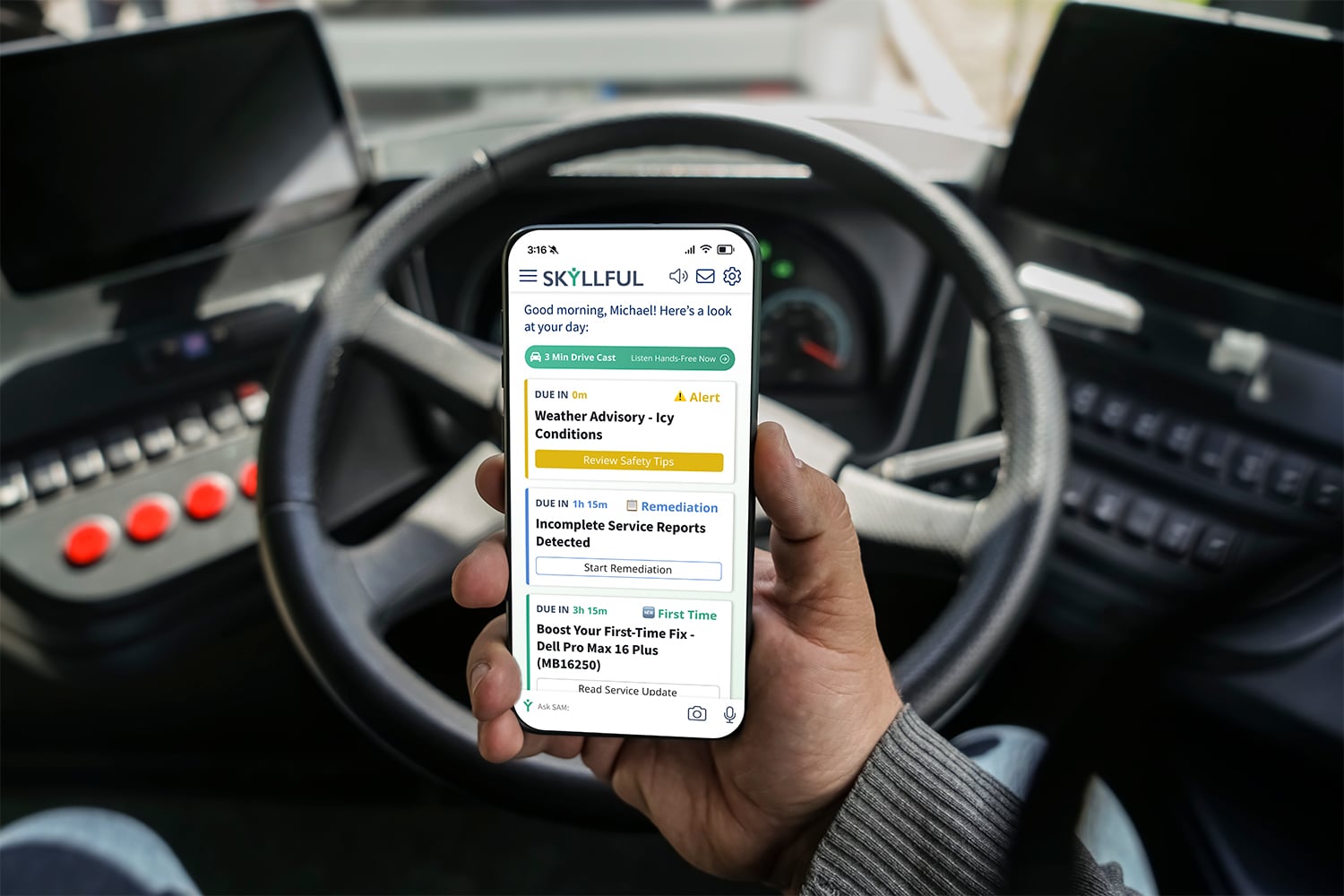
Skyllful was built with this reality in mind. The short lessons, mobile-first experience, gamification, and on-demand access are all designed to reduce friction and support workers where they are. But even the best-designed solution is still a new tool. And every new tool introduces change.
I work with operations leaders every day who are investing in the right technology, rolling out thoughtful training, and setting clear expectations. Yet many still see engagements stall after the initial launch.
The reason is simple: adoption isn't primarily a training challenge. It's a change management challenge.
And ultimately, adoption matters because it drives confidence, proficiency, and business outcomes. A training platform only creates value when workers use it consistently enough to change how they work.
The good news is that most adoption barriers are entirely solvable once you understand what your workforce is experiencing.
First, Let’s Acknowledge What Your Team Is Already Thinking
Before you can solve the adoption problem, you have to understand the resistance. Your technicians, drivers, and other frontline workers are smart. They’re measured on billable hours, job completion rates, and first-time fix rates. Every minute they spend on something that doesn’t directly contribute to their numbers is time they’re mentally accounting for.
When you hand them a new training tool, here’s what they’re actually thinking:
- “Is this going to count against my billable time?”
- “I’ve done fine without this. Why now?”
- “Is this because someone thinks I’m not doing my job right?”
- “I’ll figure it out when I need it.”
None of those are unreasonable reactions. They’re practical. And they’re exactly why top-down mandates without context rarely achieve desired results. Research backs this up: 78% of employees report better adoption when two-way communication is prioritized. And 62% adopt new systems more quickly when they receive role-based training that speaks directly to their work.
If you want adoption, you have to start by meeting your team where they are, not where you wish they were.
Readiness Comes Before Adoption
One of the most common mistakes organizations make is treating adoption as the starting point.
In reality, adoption is often the result of readiness.
When workers understand the purpose behind a change, feel capable of using the technology, and believe it will help them do their jobs more effectively, adoption follows naturally. When those conditions aren't present, even the most well-designed platform can struggle to gain traction.
This is especially true for frontline workers. Many are already balancing productivity goals, customer expectations, safety requirements, and operational pressures. A new technology initiative can easily be perceived as one more thing competing for their time and attention.
That's why successful rollouts focus on more than training completion. They focus on building confidence. Workers who feel confident are more likely to engage, practice, explore, and ultimately incorporate new technology into their daily routines.
Before you think about adoption metrics, think about readiness. Adoption is the outcome. Readiness is what makes it possible.
Why Frontline Adoption Requires a Different Approach
Most digital adoption strategies were designed for office workers sitting at desks. Frontline workers operate in a completely different environment. They're mobile. Their work is measured in productivity, service levels, and operational outcomes. They don't have the luxury of attending hour-long training sessions or searching through documentation when they need an answer.
That's why frontline digital adoption requires a different approach. Learning must be available in the flow of work, accessible on the devices workers already use, and delivered in a format that respects their time.
Skyllful was designed around these realities. The platform combines mobile-first learning, just-in-time reinforcement, role-based experiences, gamification, and operational reporting to help organizations move beyond training completion and toward workforce proficiency, confidence, and measurable business outcomes.
Part 1: Launch Strong (Because First Impressions Are Everything)
Do the First Lesson Together
This is the single highest-impact thing you can do at launch, and the most underused. At your next team meeting, before anyone goes out in the field, have everyone pull out their phones and do the first Skyllful lesson together, right there in the room.
Why does this work? Because it normalizes the behavior immediately. It removes common barriers like login issues or uncertainty about where to start. And it sends a clear signal from leadership that this isn't optional background noise. It's part of how the team operates now. It also gives you a chance to walk through the experience together and answer questions in real time. That first moment of “oh, this is actually pretty quick and easy” is powerful. People who feel capable are far more likely to come back.
Time Your Launch to Something That Already Matters
Skyllful training lands differently when it’s tied to something real. A new product launch. A software upgrade. A process change that’s already creating anxiety on the team. That’s your moment.
When training arrives alongside a change, it has immediate relevance. The lesson isn’t abstract. It’s answering a question your team already has. Instead of “why am I doing this,” they’re thinking “okay, this actually helps me.”
This is a classic L&D principle called just-in-time learning, and it works because our brains are wired to retain information we need right now. Studies show that microlearning tied to immediate application improves retention by up to 60% compared to front-loaded training with no near-term use.
Make It Part of Onboarding From Day One
Don’t wait until a new hire is two weeks into the field to enroll them in your mobile training app. The window closes fast. Once someone develops their own workarounds and habits, it’s much harder to introduce new tools.
Build your mobile training tool into your standard onboarding flow so it’s just part of how things work here. New hire orientation includes your training app. Period. This also removes an unintended message: that this training platform is a correction for existing workers. When new hires learn it from day one, it becomes culture, not remediation.
Part 2: Build the Habit (This Is the Long Game)
The launch sets the stage, but habits are what make adoption stick. Building habits requires structure, motivation, and a little friendly pressure.
Use the Leaderboard from Day One
Field techs and fleet drivers are competitive. That’s not a stereotype. It’s something I’ve heard directly from operations managers across dozens of organizations. Friendly competition is free motivation, and Skyllful’s leaderboard makes it visual and real.
Don’t wait a few weeks to introduce it. Turn it on from the first day of launch and make it visible. Call it out in team meetings. Reference it casually. The team will do the rest.
Create a Simple Rewards Program
You don’t need a complex incentive structure. What you need is a clear signal that consistent engagement is noticed and valued. A gift card for hitting a weekly streak. A public shoutout in the team channel. An extra hour of PTO for reaching a milestone. These aren’t big costs, and the ROI on engagement is real.
Research from eLearning Industry shows organizations using microlearning with structured engagement programs see 50% higher engagement and 17% greater job satisfaction. Those aren’t just training metrics. They’re retention metrics too. In an industry where 55% of frontline workers considered quitting in 2024, that matters.
Find Your Internal Champions Before Launch
Every team has early adopters. The tech-forward ones, the people who like to be “in the know,” the natural influencers their peers actually listen to. Identify them before you launch. Give them early access. Let them become the people who already know how it works by the time everyone else starts.
Peer advocacy is one of the most powerful levers in change management. When a skeptical veteran hears from a coworker, “honestly, it’s pretty quick and it helped me close that job faster,” it carries far more weight than anything that comes from management. Build your internal champion network intentionally, not by accident.
Keep Manager Visibility High
Adoption follows leadership attention. When a manager is checking the completion dashboard and mentioning it in the field, workers notice. When a manager doesn’t engage with it at all, workers notice that too.
Give your managers a simple, clear expectation: check the dashboard weekly and mention one thing they saw in their next team touchpoint. That’s it. That small act of attention from a direct supervisor is one of the most reliable drivers of sustained engagement I’ve seen across my career.
Part 3: Respect the Team’s Time (This One Is Non-Negotiable)
Frontline workers have their time tracked, billed, and scrutinized in ways that most office workers never experience. Asking a field tech to “just squeeze in a quick lesson” is asking them to absorb a hit to their metrics. They know that. If you don’t acknowledge it, you lose credibility. Fast.
Use the Gaps That Already Exist
Skyllful lessons run 3–5 minutes. That’s not a new time commitment. That’s the time a field tech already spends closing out a work order, or a food and beverage driver spends in the grocery truck line waiting to deliver.
The pitch to your team shouldn’t be “carve out time for this.” It should be “use the time that’s already slipping through.” That’s a fundamentally different ask, and it’s one your team can actually say yes to.
I’ve seen this framing completely change the reception of a Skyllful rollout. One simple mindset shift, from “extra thing” to “better use of time that’s already lost,” takes it from a burden to a no-brainer.
Account for Training Time Structurally
Telling your techs “don’t worry about your billable hours numbers” doesn’t change anything. The targets are still there. The reports still run. The anxiety doesn’t go away just because a manager said it should.
The real fix is structural: add a training time category in your FSM or scheduling system. When the system accounts for training time as a recognized, coded activity, the anxiety disappears. Your team isn’t stealing time; they’re using allocated time. That’s a completely different psychological experience, and it makes a measurable difference in participation.
This is a change management principle that often gets overlooked in technology rollouts: if you want different behavior, change the environment, not just the message. Prosci’s research consistently shows that structural enablement, not just communication, is one of the top drivers of adoption success.
Show the ROI Early and Often
Your team doesn’t need to be convinced that learning is good in the abstract. They need to see that this specific training makes their specific job easier and faster. And you have the data to prove it.
Prepared techs close jobs faster. They have fewer callbacks. Ultimately, that's the goal, not training completion, but improved operational performance.
Don’t assume that’s obvious. Show it. Pull the data at 30 days and at 60 days. Share it with the team. Not as a gotcha for the people who aren’t engaging, but as proof that the people who are engaging are getting real results. When your team sees that the people using the training app are the ones with the highest first-time fix rates or the least inventory issues, the conversation changes.
Part 4: Additional Strategies That Don’t Get Talked About Enough
Build a Feedback Loop
One of the fastest ways to kill adoption is to make workers feel like training is something being done to them rather than something being built for them. Give your team a voice.
Ask them which lessons are most relevant. Solicit feedback on what’s missing. Create a simple way for them to flag when a process in the app doesn’t match what actually happens in the field. When workers feel like their input shapes the training, they develop ownership. And ownership drives engagement.
This is especially important with tenured employees who may feel like the new training system is implicitly criticizing how they’ve been working. Involving them in the feedback process reframes the narrative: this isn’t about what you’ve been doing wrong, it’s about making your job easier going forward.
Don’t Ignore the “Wait and See” Crowd
In every rollout, there’s a group of early adopters, a group of active resisters, and the biggest group of all: people who are waiting to see if this is real before they invest any energy in it. They’re not opposed. They’re not enthusiastic. They’re watching.
This group moves when they see their peers getting results. They move when leadership stays consistent over weeks, not just at launch. They move when the leaderboard makes it visible that engagement is the norm, not the exception. Be patient with this group and be consistent. They’ll come around, but only if the signal stays strong past the initial excitement.
Make It Easy to Access When It Matters Most
Training that lives on a device workers already have in their hands is fundamentally different from training that requires logging into a system on a shared computer. Skyllful is designed for exactly this: on-device, on-demand, right when you need it.
Make sure your team knows they can pull up a lesson while they’re on a job if they need a refresher. That’s not a sign of weakness. That’s smart use of available resources. Normalizing in-the-moment reference-checking takes the stigma out of “I’m not sure how to do this,” which is one of the biggest quiet barriers to quality work in the field.
Skyllful also offers just-in-time training, where customers can set rules for personalized refresher lessons. If a field tech is assigned a work order for a product they haven’t serviced in months, Skyllful can ping that individual before the order starts to review the workflow steps. This also takes the pressure off tribal knowledge transfers and phoning a friend. If the workflow is easy to reference, the work gets done faster and doesn’t detract from a co-worker’s billable time.
Track Progress, Not Just Completion
Completion metrics tell you that someone clicked through a lesson. They don’t tell you if that person is actually more capable. As you track your rollout, go deeper than completion rates.
Look for correlations between training engagement and your operational KPIs: first-time fix rates, callback frequency, work order cycle times. At 30 and 60 days, you should be able to draw a line between training engagement and field performance. When you can show that data to leadership and to the team, you’ve made the case not just for the mobile training app, but for continuous learning as a business strategy.
The Bottom Line
Adoption doesn't happen because you announced a new tool. It happens because you've removed barriers, built confidence, demonstrated value, and remained consistent long enough for new habits to form.
The organizations I've seen achieve the strongest results with Skyllful have a few things in common. They launch with intention. They prepare their workforce for change. They keep managers actively engaged. They respect the operational realities of frontline work. And they continuously connect training to meaningful business outcomes.
Most importantly, they focus on readiness before they focus on adoption.
Frontline workers deserve more than access to technology. They deserve the confidence to use it effectively, the support to build proficiency, and the opportunity to succeed in an increasingly digital workplace.
When organizations invest in Digital Readiness, adoption becomes a natural outcome rather than an ongoing struggle. And when workers feel confident using the tools they've been given, organizations see the results where it matters most: stronger performance, better customer experiences, and measurable operational impact.
That's when training stops being an event and becomes a business strategy. If you're preparing for a technology rollout or looking to improve frontline adoption, we'd love to share what's worked for organizations across field service, distribution, manufacturing, and beyond. Come talk to us.
Candy Lovelace is VP of Customer Experience at Skyllful, where she helps organizations turn digital adoption into measurable outcomes for their frontline teams. She brings over three decades of experience in Learning & Development, having led enterprise L&D programs at National Life Group, SunTrust Bank, and Bank of America.
Supporting Research
Prosci: Digital Adoption Strategies
eLearning Industry: Microlearning Statistics 2025